

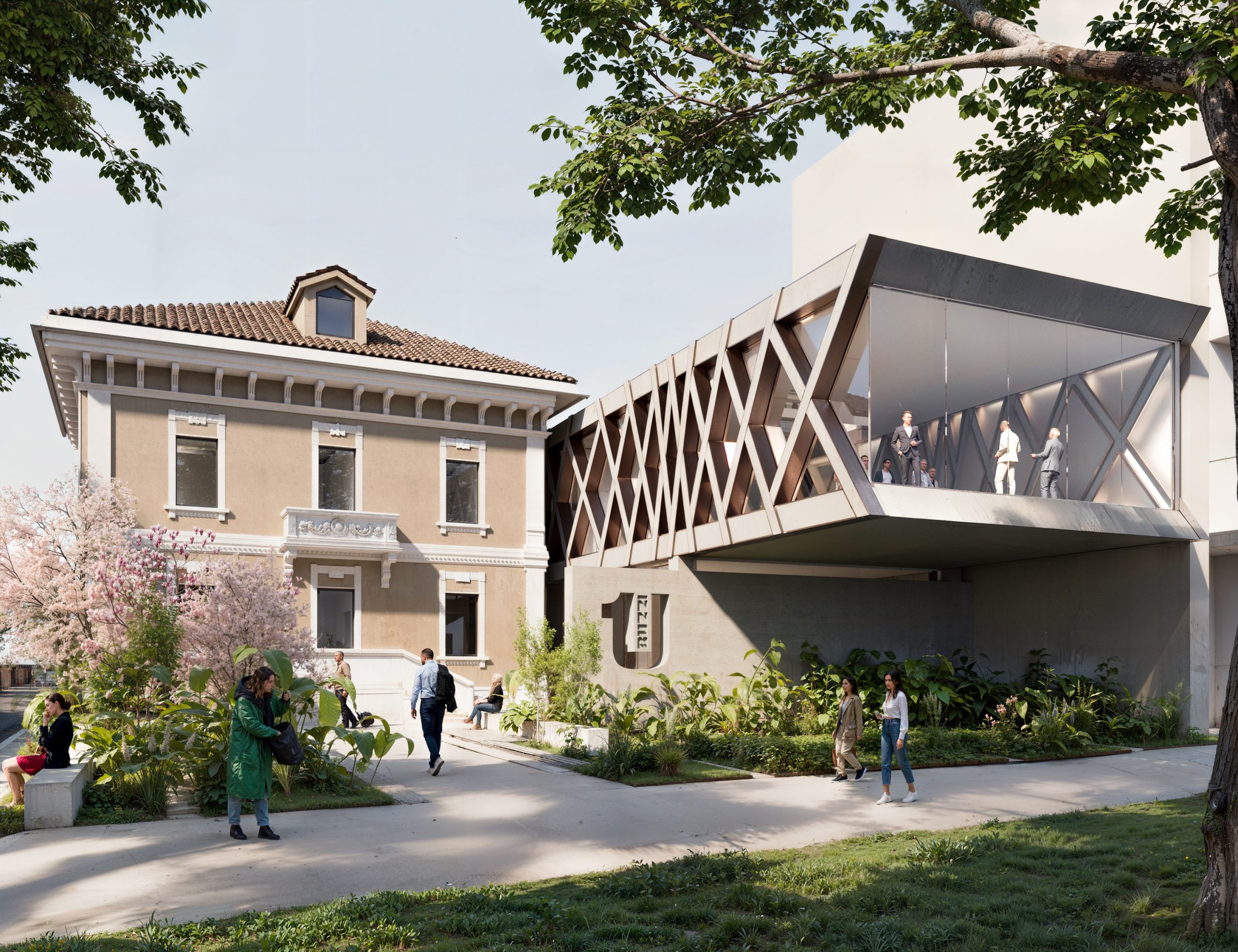
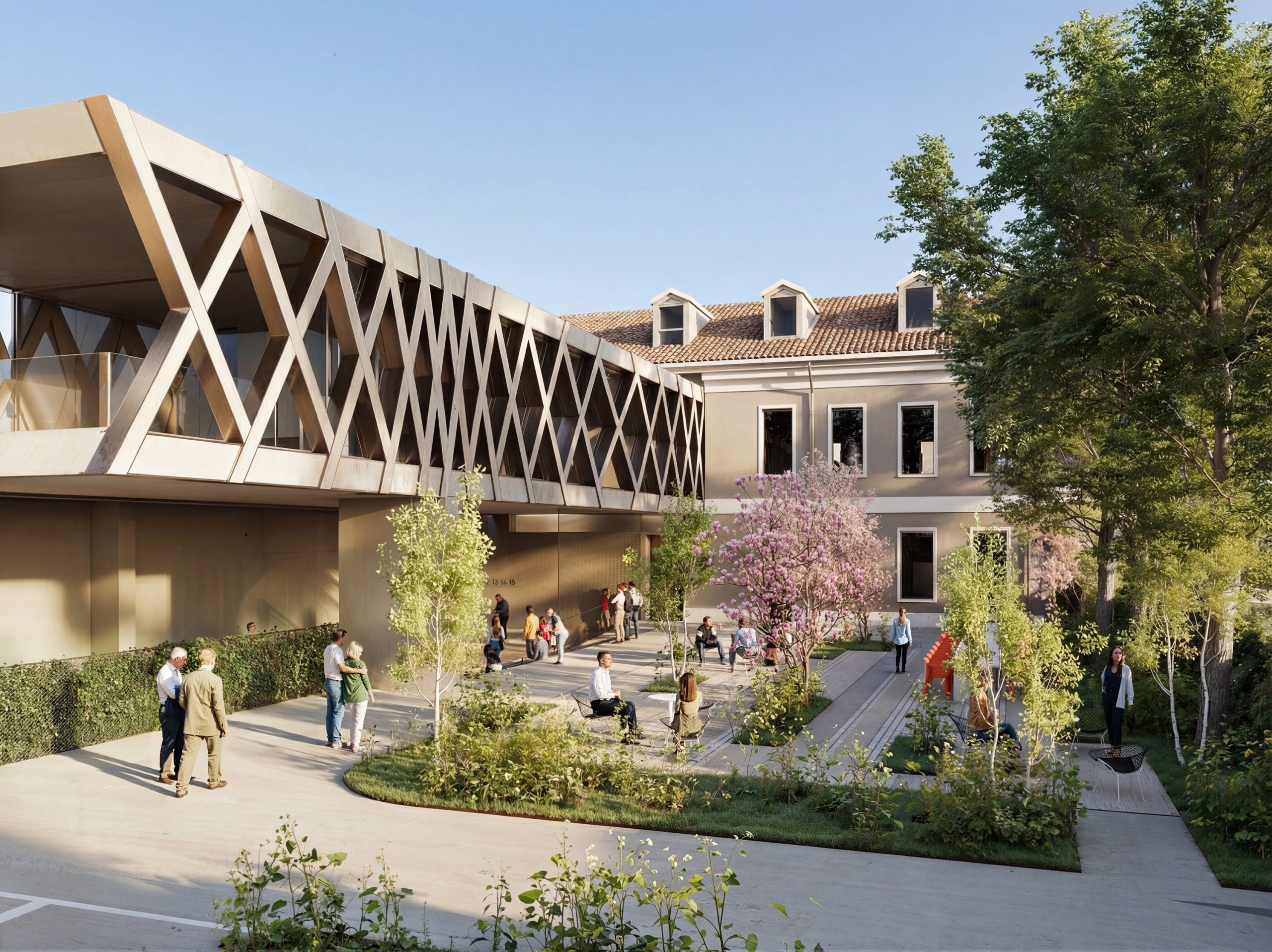
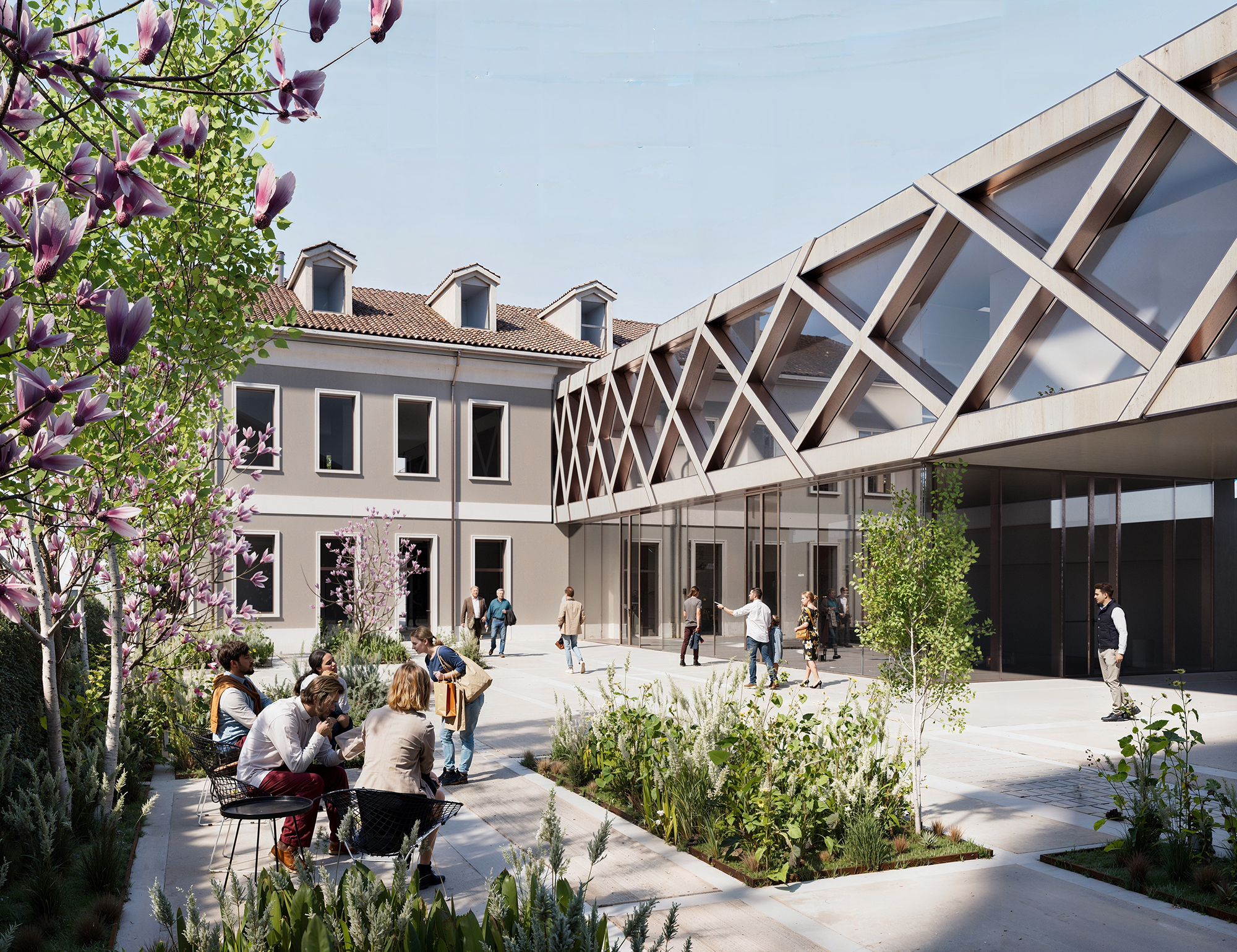
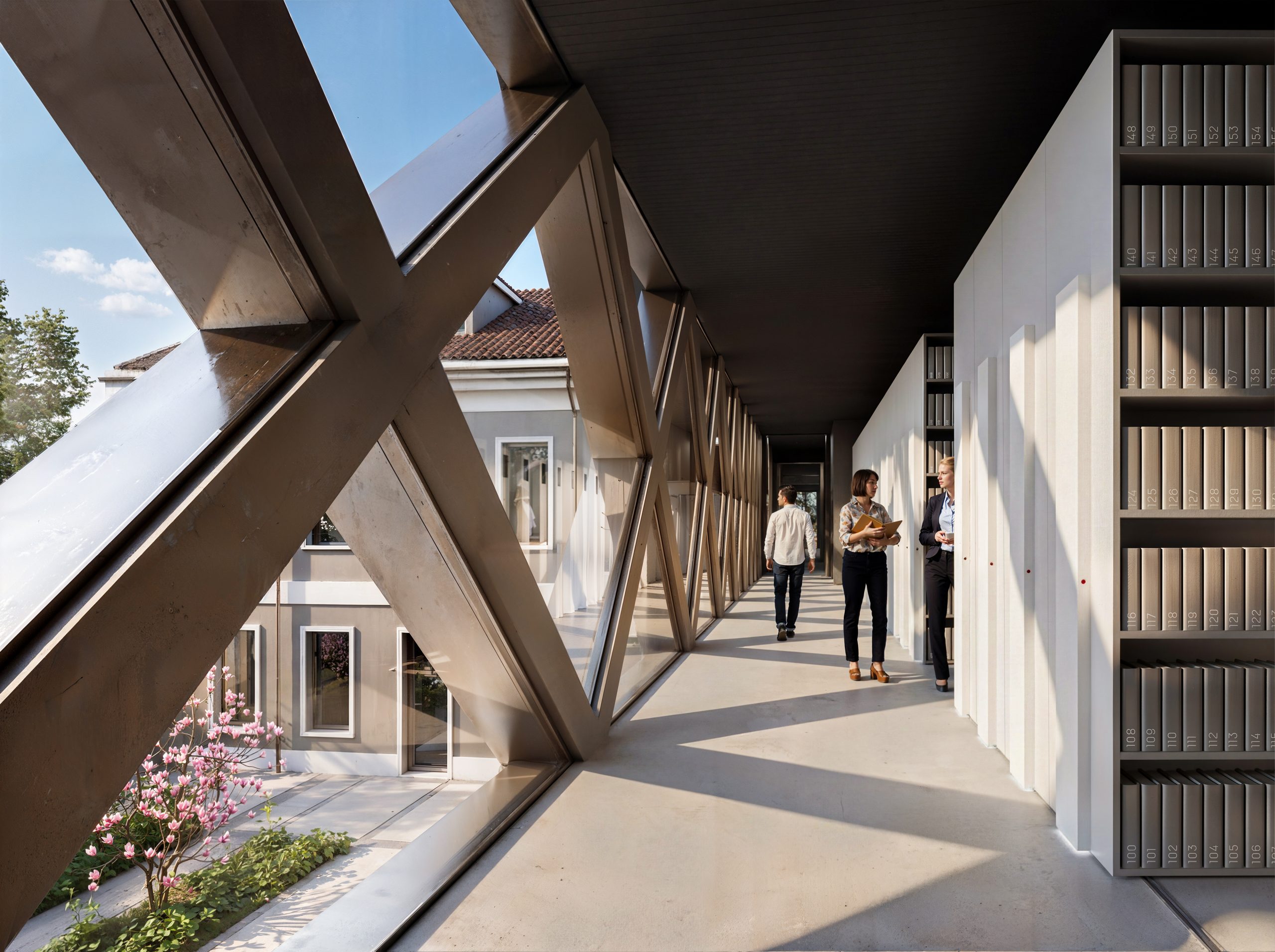
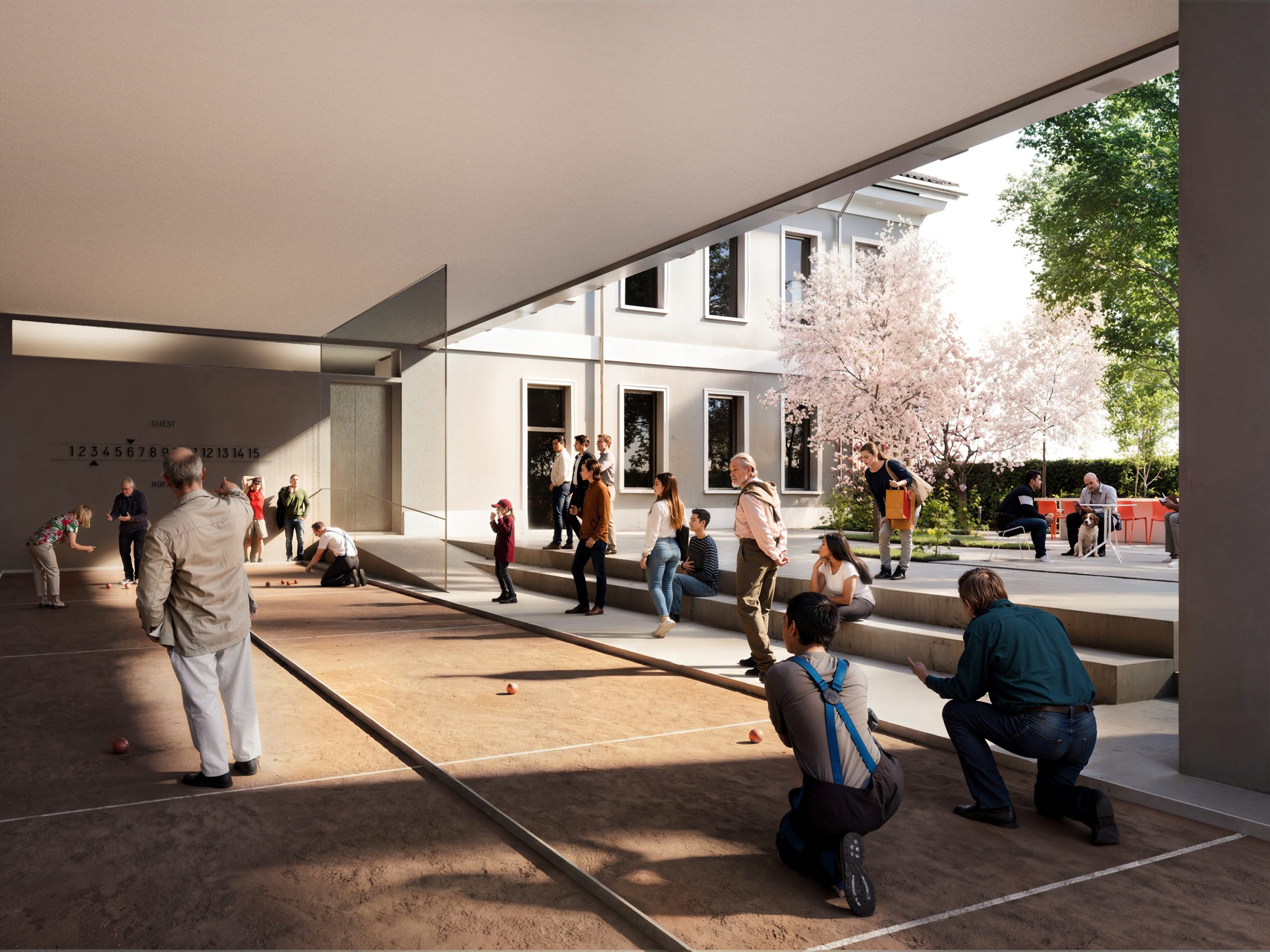
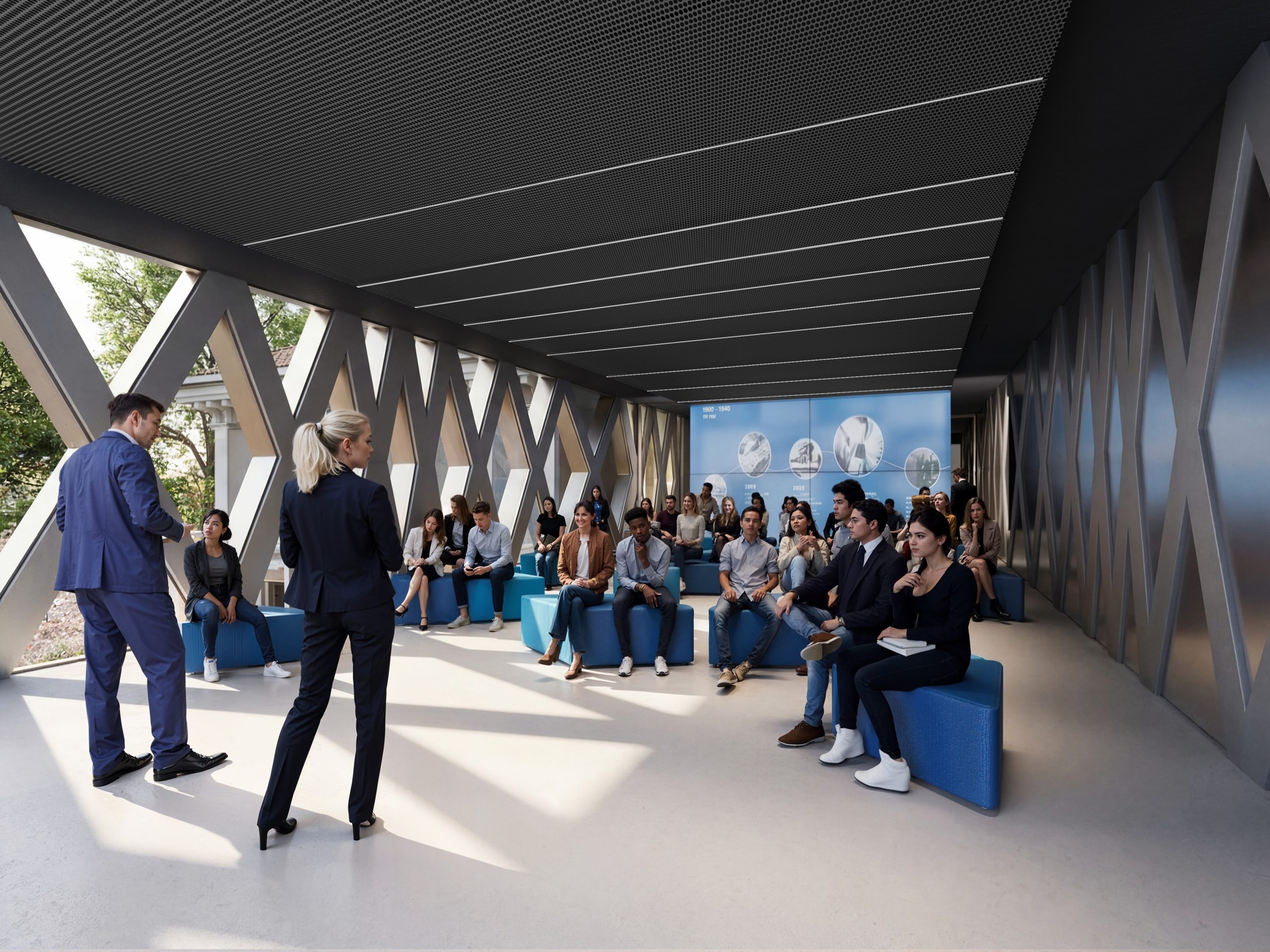
International design and innovation studio CRA-Carlo Ratti Associati has won the competition to design Buzzi Heritage’s cultural center. Located in the hometown of the multinational company, Casale Monferrato, Italy, the project explores, for the first time, how reinforced concrete could embrace digital fabrication. A 100-meter-long suspended parametric truss becomes the core of the intervention, connecting two former educational buildings and transforming the site into a publicly accessible cultural hub floating above a garden. The cantilevered structure will host Buzzi’s historical archive, research activities, and cultural initiatives under one roof, while opening the complex to the city through new public-facing green spaces.
In recent years, many construction materials—spanning steel, timber, and glass alike—have adopted digital fabrication. Reinforced concrete, however, has remained particularly impervious to innovation. Although advances in material science have significantly reduced CO₂ emissions, the fundamental process of casting concrete has remained largely unchanged for over a century. Buzzi Heritage’s cultural center rethinks this paradigm through a system that applies digital fabrication to reinforced concrete construction, centered on a 100-meter digitally fabricated truss.
The project marks the first real-world application of a patented structural system developed through research by CRA–Carlo Ratti Associati in partnership with Maestro Technologies. Traditional casting is merged with a digitally fabricated steel-concrete composite system produced through laser cutting and CNC machining. The latter serve as permanent formwork and structural reinforcement: they are fabricated off-site, used for casting, and assembled on site with millimeter-level precision. Unlike temporary formwork, these metal components remain in place, improving structural performance while reducing material waste, construction time, and on-site complexity.
At ground level, the cantilevered truss creates a sequence of three courtyards arranged along a gradual transition from public to private. The first courtyard is fully open to the city; the second is shared between public and private uses—hosting everyday activities and informal gatherings—and the third is reserved for the nonprofit Centro Incontro Fondazione Maurizio Buzzi’s social functions. This sequence mediates between public openness and private green spaces and allows accommodating evolving uses over time.
“We appointed Carlo Ratti Associati following an international competition for their ability to translate material research into built form. This project represents a concrete testing ground where architectural design, structural innovation, and industrial research converge. The concrete mix design has been specifically developed by Buzzi’s Research and Development laboratories to optimize performance according to the distinct structural and functional requirements of each component, demonstrating how advanced construction systems can be directly informed by material science,” says Luigi Buzzi, Chief Technology Officer of Buzzi.
Carlo Ratti, Professor at MIT and the Politecnico di Milano and co-founder of CRA-Carlo Ratti Associati, adds: “Today we must design for precision, adaptability, and circularity at the end of a building’s life. This new method of digital fabrication allows us to bring new intelligence to reinforced concrete.”
The project continues CRA’s long-term research into experimental construction techniques, adaptive reuse, and the integration of cultural life. CRA-Carlo Ratti Associati’s approach explores how existing heritage structures can be transformed through inventive design strategies, with a focus on cultural activation at each site. Setting precedent is AGO Modena Fabbriche Culturali, a large-scale transformation of an 18th-century hospital complex in Modena into one of Southern Europe’s largest multidisciplinary cultural and innovation hubs. There, CRA and Italo Rota embed a triangular plaza beneath an origami-inspired kinetic roof, designed in collaboration with artist-engineer Chuck Hoberman.
CREDITS
CRA team: Carlo Ratti, Andrea Cassi (partner-in-charge), Chiara Morandini (Project Manager), Iratxe De Dios, Francesco Rabuffetti; Graphics team: Gary Di Silvio, Pasquale Milieri; Strategy & Innovation: Luca Bussolino, Camilla Nicolini
Consultants: Structures: Ingembp; MEP Systems: Projema; Acoustics: Vibes; Landscape: Studio Laura Gatti; Lighting: LFB